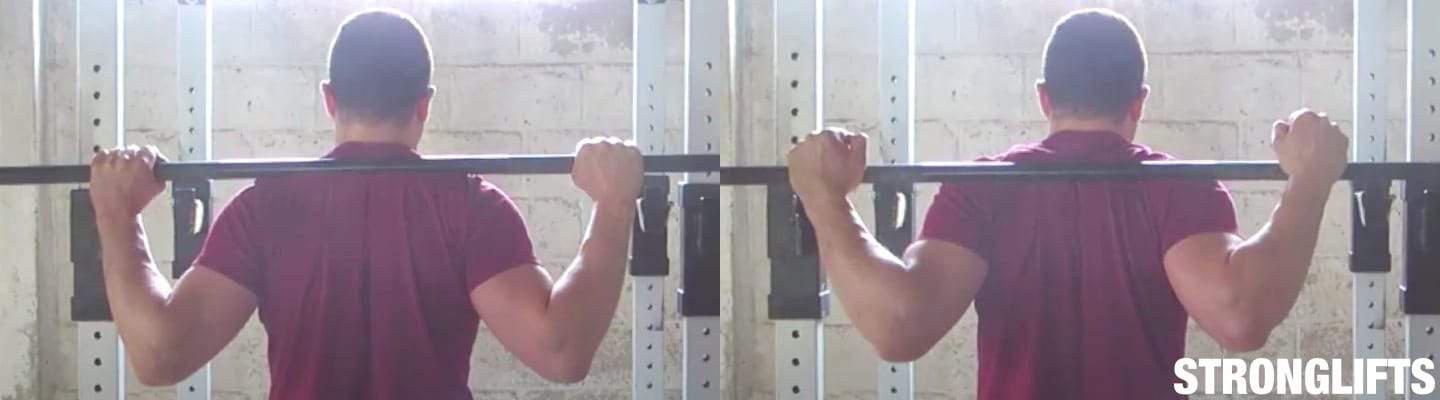
Low Bar Position for Squats
The bar position during Squats influences your torso position. Bad positioning can not only mess with your Squat technique, it can also feel uncomfortable. Shoulder, wrist & neck pain are common during Squats.
Some solve neck pain by wrapping a towel around the bar or using a bar pad. This post will show you a better approach: putting the bar correctly on your back, and what to do if you struggle with that position.
High Bar vs. Low Bar Squats. Olympic weightlifters Squat high bar: it simulates the upright torso position during their competition lifts. You can, however, Squat more weight low bar, like Powerlifters do.
- High Bar Position. The bar rests on top of your traps. This increases the distance from bar to hips. Your torso ends more upright to keep the bar above the center of your feet. Quads & hips work equally.
- Low Bar Position. Bar on top of your scapular spine. The distance bar to hips decreases, forcing you to lean forward to keep balance. You can sit back more, thereby emphasizing your posterior chain.
Should You Squat Low or High Bar? High bar is easier on your shoulders and allows for more depth. High bar could also feel friendlier on your lower back if you have long legs/short torso like me (less forward lean).
If you are, however, like most people, you lack hip mobility. Your back will round when Squatting deep, increasing risks of injury. Unless you can Squat high bar correctly and it feels more comfortable, stick with low bar Squats.
Common Pains using The Low Bar Position. Lack of flexibility often prevents correct technique. Some things that tend to go wrong:
- Shoulder Pain. You lack shoulder mobility. The low bar position feels uncomfortable on your front shoulders/chest/upper-back.
- Wrist Pain. Your hands support the bar instead of your upper-back. Your wrists hurt when squatting with heavier weights.
- Neck Pain. The bar rests on your spine instead of on your upper-back muscles. Biceps might even go numb during heavy Squats.
Correct Low Bar Squat Position. Don’t wrap a towel around the bar or use a bar pad because it hurts. Both add inches to the bar, messing up with your technique. Start light so your skin toughens up and learn correct technique.
- Bar on Scapular Spine. The bone on top of your shoulder-blades. Put the bar just above your scapular spine for low bar Squats.
- Tight Upper-back. Imagine I put a pen between your shoulder-blades and you try to squeeze it. Chest up and shoulder-blades back.
- Narrow Grip. Makes it easier to tighten your upper-back. Grip the bar as narrow as you can and pull your elbows back.
- Straight Wrists. They shouldn’t be perfectly straight, but also not bent under the bar. Your back supports the weight, not your wrists.
- Shrug Your Lower Traps. Gives the bar extra support. Don’t pull your shoulders against your ears, shrug your upper-back.

Tight upper-back, lower traps shrugged.
Mobility Exercises. Widen your grip if your wrists keep bending under the bar or if it feels uncomfortable. Work on mobility 3-4x/week. Narrow your grip as your upper-body flexibility improves.
- Shoulder Dislocations. Improve upper-body flexibility. If you can’t do them right, you can’t Squat. Focus on proper technique.
- Soft Tissue Work. Get a foam roller and work your pecs, upper-back, lats. Work through the pain, it means you need it.
- Thoracic Mobility. Helps getting rid of the slouching shoulders/round upper-back. Spend a lot of time on thoracic extension.
- Hip Mobility. Lack of thoracic mobility is linked with lack of hip mobility. Check the hip mobility post and magnificent mobility for more.
- Strengthen Your Upper-back. External rotations, scapular wall slides, scap push-ups, … will teach you to keep your shoulders-blades tight.
Last tip: keep Squatting. The low bar Squat position works as an upper-body stretch. Squat a lot & often, and you’ll improve.


I found this post to be particularly timely because this morning I happened to naturally fall into the low bar position after years of doing squats with the bar squarely on my shoulders like we learned in high school. I started inching my hands closer together and found I had more control over the bar until eventually it fell onto my scapular spine (though I didn’t know at the time that’s what it was called). At first I thought I might drop the bar, but after doing a couple of deep squats, I noticed I wasn’t bending my back as much as usual and had a lot more control over the bar. I figured it was at least an interesting data point and maybe worth trying again, and then less than three hours later I see this post about low bar squats and my own experience has a little bit more perspective.
Thanks for the tips.
Great post Mehdi
@Brain yeah I just learned high bar position from my high school as well
Good post Mehdi !
I switched to low bar during a deload a few months ago, after experiencing back pain and discomfort (rounding lower back at the bottom) on high bar squats. At first low bar was uncomfortable (shoulder flexibility issue) but after a few weeks it feels natural, and a lot more stable than high bar. I’m up another 30lbs past where I deloaded last time, thanks to the focus on posterior chain (I feel it in my hips/hamstrings a lot more than high bar position). No back pain yet either. Definitely give it a go if you haven’t yet.
Good timing! I was helping my wife last night with her squats and she wanted to know if she could use padding so the bar wouldn’t hurt her neck. We’ll work on the bar placement tomorrow night. Thanks!
I find I can squat just to parallel or a couple inches below with high bar without my lower back rounding too much, but if I switch to low bar my lower back rounds like crazy because I have to lean over so much. How then is high bar worse for people with limited flexibility than low bar?
I think I’ve recently figured out how to do the low-bar position. The key piece of info that helped me find it isn’t in this article, though. For me, it was really important to get under the bar, and play around with its positioning. When I STILL couldn’t find any other position than high-bar position, I started playing around with my elbow positioning. While they naturally pointed down, I needed to rotate them away from the floor and more out. I didn’t think I would be able to do that because my shoulders are quite stiff, but when I was actually under the bar I found that rotating my elbows out opened up a secure ledge for the bar to sit on. Once I opened the ledge up, I still needed to slowly work my hands closer together to tighten up my back and make the ledge secure, but without actually playing around under the bar and trying something that I thought would be impossible (rotating my elbows out while gripping the bar), I would still be struggling to find the spot.
I had struggled for over six months to find the spot, and it finally took playing around with the bar and trying everything I could change until I finally found it.
Had I not found low-bar position (with the help of Mehdi in the forums), I don’t think this post would have helped. This post describes what good low-bar position is, but not the steps that you should go through to try and find it for yourself.
Sorry, bit of a ramble…
I need to ask this question to Medhi or any experienced squatters that can answer my question..when doing the low-bar squat, everytime i squat down, my toes point out more and more…is this natural, or is it a problem? can i do anything to fix that?
@elVarouza
You can’t go deep with a low bar squat (too much forward lean). While you can go much deeper with high bar (more upright position). If you’re tight in the hips, your back will round more easily when going deeper, while it it won’t when stopping at parallel.
There are many other reasons your back can round btw.
@Marvin
Shoot a video and post it in the forum.
My shoulders feel like they’re going to rip off when I do squats.
I have been doing shoulder dislocations and they’ve helped a little.
My arms go numb after a while of keeping my shoulder blades pinched together.
I’ve also been using a wooden broom stick to stretch my shoulders and help it get used to the arm position for squats.
Both arms go numb with pins and needles.
Any recommendation on how to fix this?
@Nocturnal
Continue working on flexibility, make sure you put the bar correctly on your back, arms going numb usually happens when the bar sits on your spine. The rest is practice.
The low bar does just not feel right to me. I may be doing it wrong, but whenever I try it, it feels like I’m holding the bar up with my arms more than my back. I’m relatively tall and have worked a lot on my flexibility to be able to go deeper and keep my back from rounding when I go past parallel. Is low bar that much better or should I just keep working on my form and flexibility?